The Inverted Spiral: How Impunity Compounds, Who Blesses It, and Why the Blind Are Blamed for the Darkness

THOSE WHO PUT OUT THE PEOPLE’S EYES
Milton wrote it in 1642, about censors and prelates: those who put out the people’s eyes reproach them for their blindness. Four centuries later the sentence fits without changing a word. The blinding operation never needed new technology. Only new vocabulary.
This is an article about that vocabulary — about how lawlessness compounds by a mathematics anyone can follow, how an old moral language predicted every stage of it, how the whole machine learned to describe itself as freedom, and why the final move is always the same: blame the robbed for the robbery, the blinded for the dark.
THE MATHEMATICS OF IMPUNITY
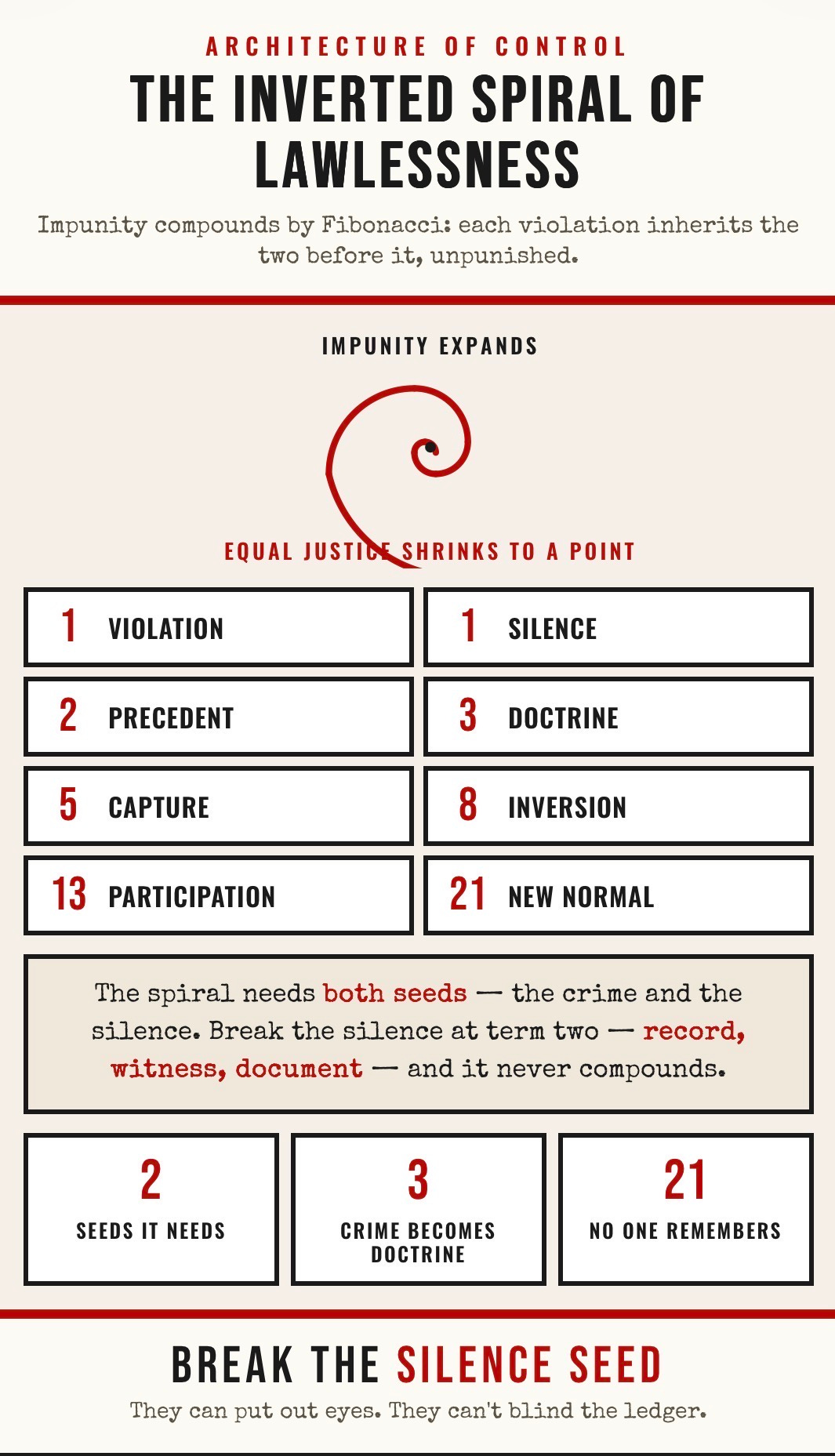
The Fibonacci sequence works by one rule: each term is the sum of the two before it. One, one, two, three, five, eight, thirteen, twenty-one. Nothing dramatic happens early. Then the curve turns vertical.
Applied to power, the rule becomes this: each violation inherits the full weight of the two that preceded it unpunished. Nothing is forgotten by the system. Everything compounds.
Term one is the first violation. Small. A norm bent, a disclosure skipped, an oath treated as ceremony. Deniable. Everyone agrees it is not worth the fight.
Term one, again — because the sequence needs two seeds — is the first silence. Not a violation itself but the decision that the violation costs nothing. The declined prosecution. The board that looks away. The editor who spikes the story. This is the seed value most people miss. The spiral is not built from crimes. It is built from crimes plus silences.
Term two: violation plus silence equals precedent. The second act cites the first. This was tolerated before. The rule is now empirical, not written.
Term three: precedent plus new violation equals doctrine. The lawyers arrive. What was a breach becomes a theory — expansive immunity, the unitary executive, official acts. The breach gets a name and a footnote.
Term five: doctrine plus precedent equals capture. The referees are replaced with players. Courts, inspectors general, oversight bodies staffed by the people who benefit from the doctrine. Enforcement now requires permission from the enforced-against.
Term eight: capture plus doctrine equals inversion. The law still operates at full force — but only downward. Prosecution becomes something done to the powerless by the immune. Equal justice inverts into its exact negative.
Term thirteen: inversion plus capture equals participation. Compliance itself becomes complicity. Institutions, churches, corporations, agencies must join the racket to survive it. Neutrality is eliminated as an option.
Term twenty-one: participation plus inversion equals the new normal. The founding violation is no longer visible. Children raised inside the spiral cannot see it, the way a fish cannot see water. Heaven’s law is not defied anymore. It is unremembered.
The geometry matters. A true Fibonacci spiral opens outward — growth, the nautilus, the sunflower. The inverted spiral does the same math in reverse moral polarity. It opens outward too, but what expands is the zone of impunity, and what contracts toward the center is the shrinking territory where law still applies to everyone. Until that center is a point. And then nothing.
— The spiral is not built from crimes. It is built from crimes plus silences. —
THE OLD NAMES FOR THE FUEL
The spiral describes mechanics. It does not describe motive. For motive, an older vocabulary already did the work, and it maps onto the terms with uncomfortable precision.
The first violation is Greed. The seed act is nearly always acquisitive — the skimmed contract, the undisclosed gift, the office used as instrument. Avarice starts spirals because it is the sin that scales.
The first silence is Sloth — not laziness, but what the medieval theologians called acedia: spiritual apathy, the refusal to care when caring costs something. The second seed value is a sin of omission, which is why it goes unconfessed.
Precedent runs on Envy. He got away with it becomes why shouldn’t I. Envy is the transmission mechanism — how one actor’s impunity becomes everyone’s ambition.
Doctrine is Pride. The theorizing stage is pure hubris: the belief that power deserves exemption, that the office sanctifies the man rather than binding him. Pride is the sin that hires the lawyers. Gregory the Great ranked it the root of all seven, and in the spiral it sits exactly at the inflection point — the moment violation stops being furtive and starts being justified. Everything before pride is opportunistic. Everything after it is systematic.
Capture is Gluttony — consumption past need. Not one court but the judiciary. Not one agency but the machinery entire. Gluttony is greed that has stopped counting.
Inversion is Wrath. Once the law points only downward, it becomes an instrument of rage — prosecution as punishment of enemies, enforcement as vengeance. Wrath is what the inverted law feels like to the people beneath it.
Participation is Lust in its older meaning — disordered desire, wanting what corrupts you. Institutions do not join the racket reluctantly. They develop appetite for it. Proximity to power becomes its own craving.
And term twenty-one is no sin at all. That is the horror of it. The traditional schema assumed sin requires knowledge. The final term is where the spiral escapes moral vocabulary entirely, because a generation raised inside it has no concept against which to measure the fall. The sins got you here. Then they dissolve into custom.
THE GOD THAT CANNOT CONVICT
Every term of the spiral requires that some referee stand down. And for the last half century, a ready-made justification has been supplied for each stand-down: regulation is interference, enforcement is picking winners, oversight distorts the price signal. Let the market decide.
Understand what that phrase does structurally. It takes term two — the silence, the non-enforcement, the decision that violation costs nothing — and rebrands it as principle. Acedia in a suit. The prosecutor who declines is derelict. The deregulator who declines is principled. Same omission, different vestments.
And there is a deeper substitution underneath, which is why the rhetoric always sounds faintly theological. It does not abolish the transcendent lawgiver. It replaces one. The Market becomes the invisible-hand deity whose judgments are definitionally just: if the outcome happened, it was deserved. If you lost, you were inefficient. That is theodicy, not economics. It answers the oldest question — who watches the powerful — with an abstraction that structurally cannot convict them, because whatever the powerful did is, by definition, the market outcome.
The laws of heaven bound kings. The law of the market acquits them by design.
To be fair to the theory: its serious adherents would say this describes crony capitalism, not their position — that they oppose the capture stage most of all, that genuine free markets require fierce enforcement of fraud and contract. On their account the referee is not removed, only restricted to a narrower rulebook. The honest critique is not that the philosophy endorses the spiral. It is that the slogan gets deployed selectively in practice — market discipline for the governed, subsidy and immunity for the connected. The words do the work of term two whether or not the philosophy intended it.
— The old faith said even the king kneels. The new one says the king’s winnings are the proof he never needed to. —
THE ARC AND THE LEDGER
You were told the arc of the moral universe is long, but it bends toward justice. You believed it — not naively, but because the evidence seemed real. Slavery ended. Women voted. The courthouse doors opened, slowly, to people they had been built to exclude. The arc bent, and the bending felt like proof that the universe kept books, and that eventually the books balanced.
Then you watched the books get bought.
Two religions have been running in this country the whole time, and only one of them was ever written down. The first says there are laws above power — call them the laws of heaven, call them the Constitution, call them equal justice under law. The wording changes; the claim does not. It says the king answers to something. It says the ledger is moral, and everyone’s name is in it.
The second religion also has a ledger — but its ledger is only money, and it recognizes no names, only balances. Lose your pension? Inefficient. Lose your town? Creative destruction. Lose your case against the company that poisoned your water? The cost of doing business. Their business. Your cost.
The cruel irony is not that the second religion won a war against the first. It is that it wore the first one’s robes while gutting it. Nobody stood up and repealed the moral arc. Instead, the language of freedom was borrowed to describe abandonment. The referee walking off the field was renamed liberty. The silence that lets every corruption compound was renamed principle.
So the question arrives, and it feels unbearable: was the arc ever real?
It was. But read the fine print you were never shown. The arc was never a natural law. It was labor. It bent because abolitionists bent it, because suffragists bent it, because organizers and witnesses and stubborn documentarians put their weight on it for generations and did not let go. The universe does not keep the books. People keep the books. That is the part the famous line always contained and comfort always edited out.
WHAT IT FEELS LIKE FROM INSIDE
It makes a person feel like a fool — and that is the cruelest part, because they were not one. The specific injury is not poverty alone but poverty plus the memory of having done everything right. You worked the years, paid the premiums, believed the deal. And the shame arrives anyway, because the religion of money has one more trick in it: it teaches the robbed to blame themselves. Should have seen it coming. Should have been smarter. The theft comes with a theology that converts the victim’s grief into the victim’s guilt. That is not an accident of the system. It is the system’s immune response. A person busy being ashamed does not organize.
Underneath the shame is rage with nowhere to land, because the thief is not a person you can face. It is a structure, a spreadsheet, a subcommittee, a doctrine. Rage needs an address, and the economy is designed not to have one. So the rage either turns inward and becomes despair, or gets captured by whoever offers it a target — usually someone poorer than the actual beneficiaries. The redirection of that anger is itself an industry.
And there is a loneliness in it that does not get named enough. Everyone performs okay-ness — the neighbors also drowning quietly, also convinced their case is a personal failure rather than a shared verdict. The gerrymandered economy works like the gerrymandered map: it packs and cracks people so they never discover they are a majority. Millions of individuals each privately concluding I lost, when the accurate sentence is we were robbed. Same facts. Entirely different politics. The first sentence isolates. The second one assembles.
— Millions of people privately concluding I lost, when the accurate sentence is we were robbed. —
THE FULL CIRCUIT
And then the machine completes itself. Break the thing, point at the wreckage, blame the people trapped under it — and when they cry out, call the crying-out the threat. Arson followed by a lecture on fire safety, delivered by the arsonist, to the people still in the burning building. The proof offered that government does not work is always a government broken on purpose: defund the agency, then cite its failures. Starve the school, then mock its scores. Sabotage the courts, then run against the ruins.
The red-baiting is the load-bearing wall. Notice what the words socialist and communist actually do in this circuit. They are not descriptions. They are jurisdiction strips. Once the label lands, the person’s claim no longer has to be answered. A worker saying you stole my pension is an accusation with evidence and an address. A socialist saying it is just ideology, and ideology can be dismissed without an audit. The label converts a creditor into an enemy — and enemies do not get paid. They get investigated. The maneuver transforms the question what happened to the money into the question what is wrong with the people asking, and the second question can be litigated forever without a single receipt changing hands.
The projection is nearly perfect, which is a signature rather than a coincidence. The people who actually centralized power — who merged state and corporate machinery, who made loyalty the price of participation in the economy, who treat law as a downward-only weapon — accuse their victims of wanting exactly that. Every accusation pre-occupies the ground the accuser is standing on, so that when the description finally fits them, the words are already spent, already coded as hysteria.
The tell, as always, is where the law points. The people shouting about lawlessness wrote themselves the immunities. The victims never needed to be socialists for the machine to work. They only needed to be blamed, because a population arguing about labels never gets around to the inventory.
THE BLINDING, ITEMIZED
Which returns us to Milton. Consider what putting out the people’s eyes means now. Gut the schools, then sneer at the ignorance. Buy the newspapers and hollow them, then mock the public for believing rumors. Flood the channels with engineered noise, then diagnose the population with gullibility. Classify the documents, seal the settlements, put the victims under NDA, then ask why nobody can prove anything.
Each act of blinding is followed, on schedule, by a taunt about blindness. The taunt is not gratuitous cruelty. It is the second half of the procedure. Blame completes the blinding, because a person convinced their darkness is their own fault stops feeling for the wall — stops suspecting there was ever a door.
And here is the inversion Milton was actually angry about: sight was never lost. It was taken. The distinction is everything. Blindness as misfortune calls for pity. Blindness as verdict calls for contempt. But blindness as injury calls for a trial — names, dates, instruments, the hand that held them. That is why the blame is applied so aggressively. It is venue-shopping. Move the case from the criminal docket to the moral one, where the victim is the defendant and the assailant appears only as an expert witness, testifying sadly to the condition of the blind.
THE INTERVENTION AT TERM TWO
The escape hatch is in the seed values, and it was there the whole time.
The spiral needs both ones — the violation and the silence. Break either seed and the recursion never compounds. Punishing early is mostly out of reach now; the capture stage saw to that. But the second seed is still contestable, every day, by anyone. Refuse the silence. Record. Witness. Document. In the old vocabulary, the counter-virtue to acedia is diligence — and diligence, unlike enforcement, cannot be captured, because it does not require anyone’s permission.
The people do not need to be told they cannot see. They know. What they need is someone who wrote down what the room looked like before the lights went out, who kept the floor plan, who can say with documentation: the darkness has an author.
Restoring sight may take a generation. Establishing authorship only takes a record that survives.
They can put out eyes. They have never once figured out how to blind the ledger.
— The answer to a stolen ledger has never changed. You keep another copy. —